
Have you ever gone outside on a scorching afternoon and wondered why the Sun feels like a giant furnace aimed straight at your face? Sure, we all know the Sun is hot, but how hot and why remains a mystery people have been trying to solve for decades. Even the Sun’s outer atmosphere, called the corona, is much hotter than its visible surface. That’s like standing in front of a campfire and realizing that the smoke is hotter than the flames!
For over 80 years, scientists have been puzzled by this strange temperature reversal, known as the “coronal heating problem.” Now, thanks to some advanced solar observations, scientists believe they’ve finally uncovered an answer—one involving magnetic waves twisting, spiraling, and shaking the Sun from the inside out.
The Puzzling Solar Paradox
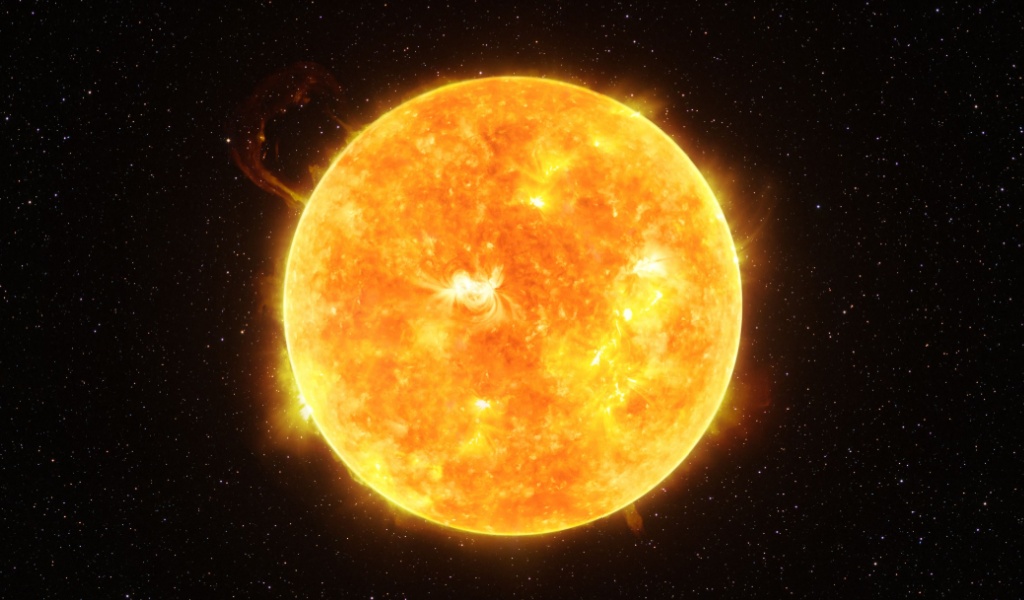
The Sun’s visible surface, the photosphere, is around 5,500°C – already hotter than anything you can imagine touching! However, just above it, the corona spikes to more than a shocking million degrees. It’s thin, wispy, and mostly empty, yet somehow hotter than the thick surface underneath it. This reversed temperature gradient perplexed solar physicists. Heat usually moves from hot to cold, not the other way around, but the Sun appears to enjoy breaking the rules.
So, what exactly is driving all that extra heat into the corona?
Torsional Alfvén Waves: The Hidden Culprit
Recent studies using the world’s most potent solar telescope, the Daniel K. Inouye Solar Telescope (DKIST), might have cracked the mystery wide open. A group led by Professor Richard Morton discovered subtle, twisting magnetic waves known as torsional Alfvén waves rippling through the Sun’s atmosphere.
Imagine the Sun’s magnetic field lines as massive, invisible ropes. Now picture those ropes twisting fast, like somebody spinning a jump rope so fast it blurs. That twisting motion sends energy outward, much like shaking heat along magnetic field lines. These waves are everywhere, continuously buzzing throughout the corona, but they were difficult to detect until now.
How Does the Corona Get Heated by These Waves?
The energy they carry is the key. Magnetic field lines carry energy upward through the corona when they twist. These waves deliver around 100 – 400 watts per square meter, which is more than sufficient to keep the corona’s temperature at over a million degrees. Simulations show something even more amazing:
- At the core of magnetic tubes, swaying how kink waves rule
- Twisting Alfvén waves take over at the edges
- The combination creates a continuous flow of energy outward
It’s like the Sun has a built-in system of magnetic escalators that continuously carry heated plasma upward.
How Scientists Eventually Discovered Them
To observe these magnetic waves, scientists used a special DKIST device, Cryo-NIRSP, a cryogenically cooled spectropolarimeter that can measure dim infrared light and delicate plasma motions. The breakthrough happened by:
Monitoring small Doppler shifts: Plasma motion changes the light wavelength. By mapping redshifts and blueshifts on opposite sides of magnetic structures, researchers identified a significant twisting pattern.
Targeting heavily ionized iron atoms: These atoms exist only at temperatures of about 1.6 million degrees, making them ideal indicators for coronal activity.
Filtering out distracting “kink” waves: Previously, telescopes kept catching bigger, more noticeable swaying motions, such as big branches moving in the wind, while missing the subtle twisting occurring beneath. Morton’s team built clever models to subtract the noise and uncover the hidden spirals.
After that, the evidence was clear: torsional Alfvén waves were everywhere, moving at about 19–20 km/s.

Why It Took Eight Decades to Find a Solution
So why wasn’t this figured out earlier? Three reasons:
- The waves are delicate
- The corona is extremely thin
- Past telescopes weren’t powerful enough
The Link to Solar Wind
These twisting waves not only heat the corona but may also contribute to the formation of the solar wind, which is the continuous stream of charged particles coming from the Sun at hundreds of kilometers per second. Understanding how this happens is elemental since the solar wind affects the Earth by:
- Damaging satellites
- Forming auroras
- Putting astronauts at risk
- Causing problems with GPS
- Affecting power grids
Solving the coronal heating issue also brings us closer to forecasting dangerous space weather.
What Next?
Professors are not done with their research yet. They want to observe:
- How these waves change farther from the Sun
- How solar wind and waves interact
- Where precisely the magnetic energy turns into heat
They’re combining DKIST information with observations from NASA’s Parker Solar Probe, which is flying through the corona. Together, these tools may completely map the Sun’s magnetic heating system. One thing’s for sure: we’re heading towards a golden age of solar physics!
Exposing the Sun’s Secret Dance
After decades of uncertainty, scientists finally have a convincing explanation for why the Sun’s atmosphere is hotter than its surface. The answer isn’t flare-ups or strange particles; it’s a continuous, complex dance of twisting magnetic waves spiraling through the corona. These waves transfer energy, heat plasma, and shape the solar wind. They’ve always been there, hidden just out of view, quietly driving one of the biggest mysteries in space.
So, the next time sunlight hits your face, remember that invisible magnetic waves are dancing above the Sun’s bright surface—twisting, whirling, and heating the nearby space to amazing temperatures!