
Have you ever heard of black holes? They sound like something from science fiction—cosmic beasts that gulp stars, warp time, and hold secrets about the universe. Yet they’re real, and scientists have studied them for years. Despite the name, black holes aren’t actually holes but incredibly dense objects with gravity so strong that nothing escapes once it gets too close.
From unseen giants hiding in galaxies to strange physics that bend space and time, black holes are among the most mesmerizing objects in the cosmos. Here are some interesting facts that make black holes among the universe’s biggest mysteries.
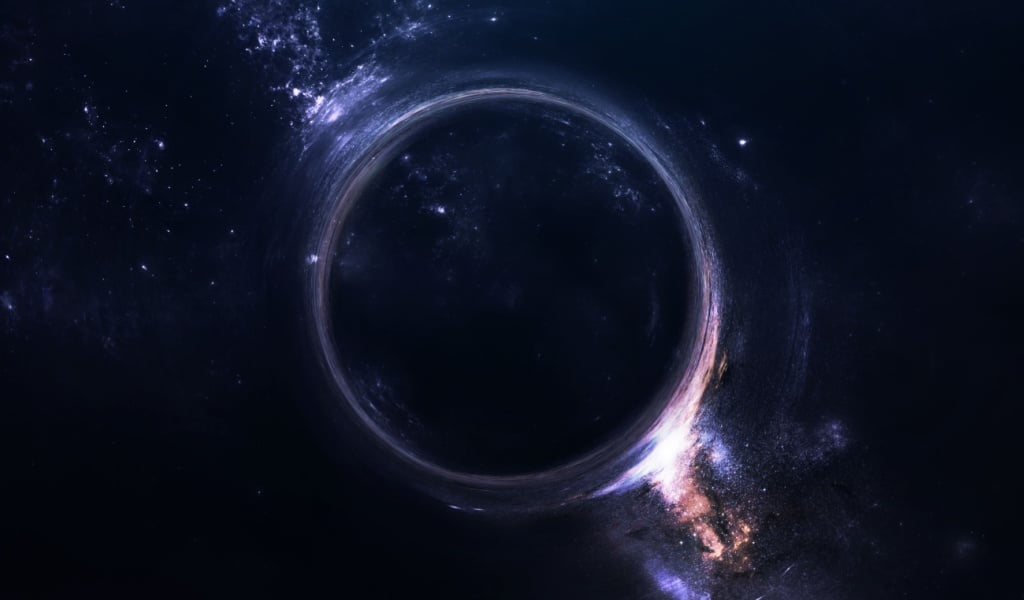
Black Holes Are Not Visible at All
Black holes are called black because they neither emit nor reflect light. Their gravity is so strong that even light cannot escape, making them undetectable to telescopes.
So how do scientists know they exist? Rather than seeing the black hole itself, astronomers examine its effects. When gas, dust, or stars get too close, they swirl into the black hole and create a glowing ring known as an “accretion disk”. The material heats significantly and emits strong radiation, particularly X-rays, which telescopes can detect.
Astronomers also observe surrounding stars. If stars orbit something invisible yet massive, it’s strong evidence that a black hole exists nearby.
The Event Horizon: The Point of No Return
Every black hole has a boundary called the “event horizon”. It’s impossible for anything to escape once it crosses this threshold.
Consider the event horizon as the cosmic point of no return. If an object moves fast enough outside of it, it may still be able to escape. But nothing in the universe can match the escape velocity inside it, as it exceeds the speed of light.
A person falling toward a black hole would seem to slow and fade as they approach the event horizon. What happens beyond this boundary remains one of physics’ great mysteries.
The Sizes of Black Holes Vary
Not all black holes are the same. Astronomers categorize them based on size and mass.
Stellar-mass black holes form when enormous stars collapse after a supernova. These black holes are much larger than the Sun.
Intermediate-mass black holes are larger and still quite mysterious, ranging from hundreds to thousands of solar masses.
Supermassive black holes are cosmic titans, containing millions to billions of solar masses and residing at the centers of galaxies.
There May Be Millions of Them in Our Galaxy
Black holes aren’t rare. According to astronomers, there may be millions, or even billions, of stellar-mass black holes in the Milky Way alone. Many are extremely difficult to detect because they don’t actively pull in matter. Without glowing gas or X-ray radiation to expose them, these silent black holes drift invisibly through space.
Singularity: The Center of a Black Hole
At the center of a black hole lies something even more strange: a singularity. A singularity is a point where matter is compressed into an extremely tiny space, creating massive density and gravitational force. The laws of physics break down here, so researchers still don’t fully understand what happens at the center.
Everything that falls into a black hole is believed to be crushed into a single, incredibly dense point eventually.
They Bend Space and Time
Besides pulling things in, black holes also warp the cosmos.
According to Einstein’s theory of relativity, massive objects bend space and time. This effect intensifies close to a black hole. Compared to the outside universe, time slows dramatically.
Imagine your friend staying safely far away as you hover close to a black hole. You may discover that your friend has aged significantly more than you if you manage to survive and return. This phenomenon, called “Gravitational time dilation,” demonstrates the true strength of black holes.
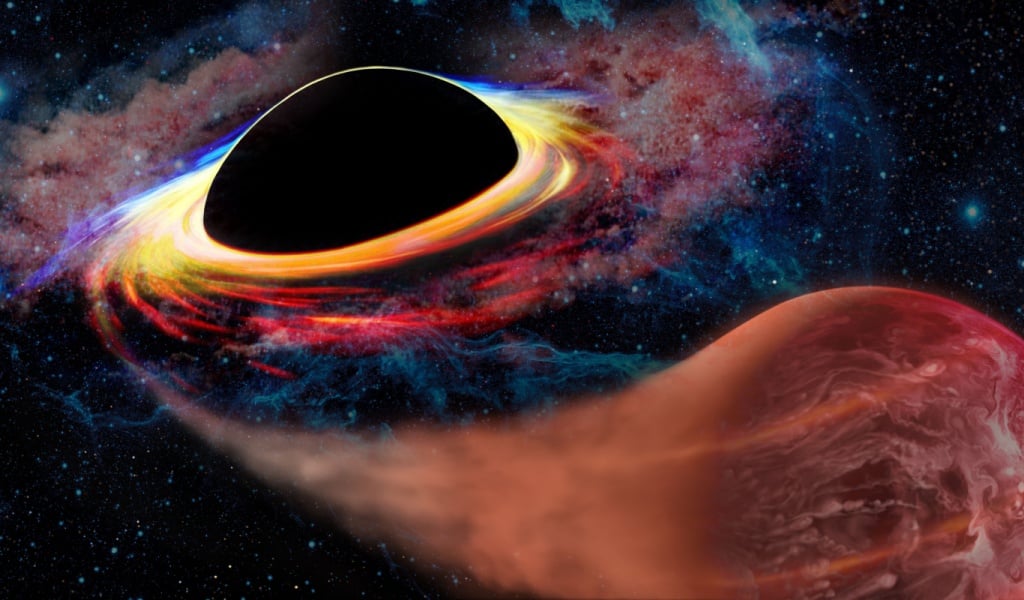
Black Holes Don’t Just Swallow Everything In
While black holes are frequently shown in movies as giant cosmic vacuum cleaners, the reality is a little different. Their gravity behaves like that of any other large object. Earth would continue to orbit the Sun in the same way that it does now (but without sunlight) if the Sun suddenly turned into a black hole with the same mass.
Objects only get swallowed if they approach the event horizon too closely; otherwise, they can orbit a black hole like planets orbit stars.
Scientists Have Finally Taken Pictures of Black Holes
For decades, black holes were only theories. That changed in 2019 when scientists took the first picture of one.
Using the Event Horizon Telescope, astronomers captured the shadow of a supermassive black hole in galaxy M87—a glowing ring of hot gas around a dark center.
Later, scientists released another photograph showing the black hole at the center of our own Milky Way galaxy. These photographs provided powerful evidence that black holes do exist.
Black Holes Can Contribute to Star Formation
Surprisingly, black holes may help create stars. Research shows supermassive black holes affect star formation in galaxies. By blasting energy and material into space, they influence how gas clouds collapse to form stars.
Occasionally, this energy shuts down star formation, while other times it triggers it. Either way, black holes play a significant role in shaping the cosmic environments surrounding them.
Thus, the universe’s most destructive objects can also aid in building new stars.
Black Holes Continue to Be Mysterious
Black holes remain one of modern science’s greatest mysteries.
What happens within the event horizon?
Can black holes connect to other parts of space—or even other worlds?
Researchers continue to learn about them using advanced telescopes, computer simulations, and gravitational-wave detectors. Each discovery brings new questions, reminding us that the universe is far more bizarre and captivating than we once imagined.
The Mysteries of the Cosmos
Black holes are more than just fascinating space phenomena; they serve as windows into the fundamental laws of physics. They distort time, bend space, and challenge everything we know about the universe.
The more scientists learn about them, the more intriguing they become. And perhaps the most remarkable fact of all is that we’re only beginning to understand them.