
IQ, or Intelligence Quotient, refers to a person’s cognitive abilities. It measures how well someone can think logically, understand new information, and solve problems. Traditionally, IQ has been seen as the main indicator of intelligence in academic and technical fields.
Some of the key abilities measured by IQ include:
- Memory (both short-term and long-term)
- Logical reasoning
- Critical thinking
- Spatial awareness
- Abstract thinking
While IQ is important, modern research shows that it represents only one part of overall intelligence.
Understanding Emotional Quotient (EQ)
Emotional Quotient, or EQ, measures emotional intelligence: the ability to understand and manage your own emotions, as well as recognize and influence the emotions of others. Although it is a newer concept than IQ, EQ is widely recognized as a factor in personal and professional success.
EQ is built on four main skills:
- Self-awareness: Recognizing your emotions as they occur
- Self-management: Controlling your reactions and behaving appropriately
- Social awareness: Understanding the emotions of others
- Relationship management: Handling interactions and relationships effectively
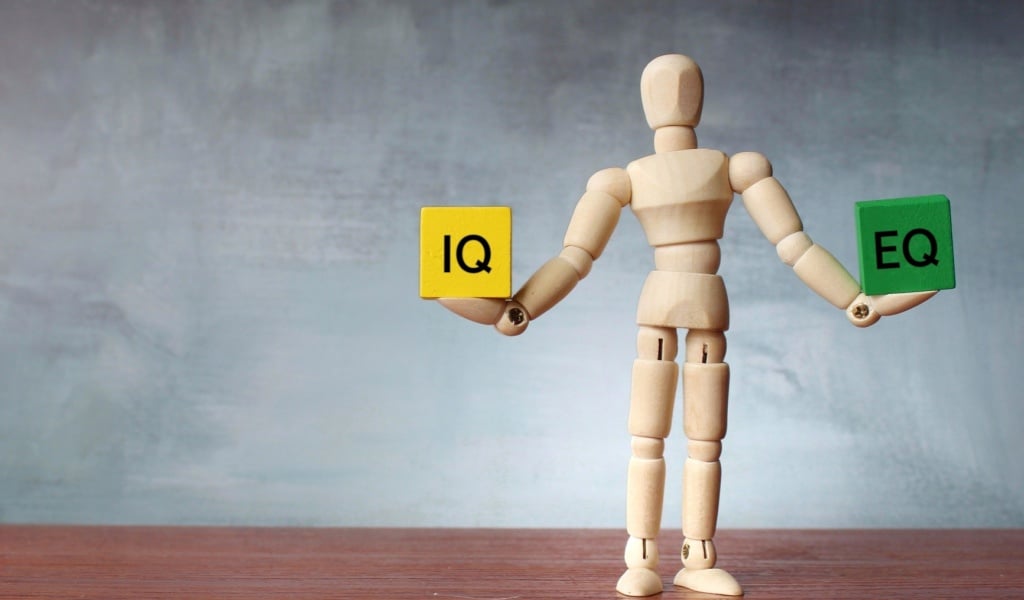
Unlike IQ, EQ focuses more on human interaction and emotional balance. This distinction makes the contrast between them clearer.
Key Differences Between IQ and EQ
Different Skill Sets
IQ is centered on intellectual abilities such as learning, reasoning, and problem-solving. By contrast, EQ focuses on emotional and social skills, including empathy, communication, and emotional regulation, that are not necessarily linked to intelligence measured by IQ.
Individual vs Relational Nature
IQ is largely individual. It reflects your personal mental abilities and is not directly influenced by how you interact with others. EQ, however, is deeply relational. It shapes how well you connect, communicate, and build relationships with people.
Different Benefits
A high IQ can help individuals excel in academics and technical careers. It improves analytical thinking, innovation, and the ability to process complex information. EQ complements these abilities by improving teamwork, leadership, and communication. People with strong EQ are often better at managing stress, resolving conflicts, and building trust.
Daniel Goleman, a leading psychologist in emotional intelligence, writes, “In a very real sense, we have two minds, one that thinks and one that feels.”
How IQ and EQ Are Measured
IQ is typically measured using standardized tests that compare a person’s performance with others in the same age group. Early methods calculated IQ using mental age and actual age, but modern approaches rely on statistical comparisons. IQ is generally considered stable over time, especially in adulthood.
Common IQ tests include:
- Stanford-Binet Intelligence Scale
- Wechsler Adult Intelligence Scale
- Wechsler Intelligence Scale for Children
- Woodcock-Johnson Tests of Cognitive Abilities
EQ, on the other hand, is measured through assessments that evaluate emotional and social skills. These may include self-report questionnaires or feedback from others.
Some commonly used EQ assessments are:
- Mayer-Salovey-Caruso Emotional Intelligence Test (MSCEIT)
- Emotional and Social Competence Inventory (ESCI)
Unlike IQ, EQ can be improved through practice, self-reflection, and life experiences.
Which Is More Important for Success?
In the past, IQ was believed to be the key predictor of success. People who performed well academically were expected to achieve more in life. While IQ still plays an important role in education and technical fields, it is no longer seen as the only factor that matters.
Research now suggests that EQ is equally important, if not more so, in many areas of life. In these settings, emotional intelligence influences how well people handle pressure, work with others, and lead teams. Employers increasingly value adaptability, resilience, motivation, and empathy.
Studies have shown that many hiring managers prefer candidates with high EQ, even if their IQ is average. Strong emotional intelligence often leads to better leadership, stronger relationships, and long-term career success.
According to a survey by TalentSmart, 90% of top performers in the workplace also score high in emotional intelligence, while only 20% of bottom performers do.

The Role of Environment and Bias
Both IQ and EQ are influenced by environmental factors. Education, upbringing, nutrition, and life experiences all play a role in shaping a person’s abilities. As a result, neither IQ nor EQ is completely fixed or purely genetic.
It is also important to recognize that testing methods may have limitations. IQ tests, for example, have been criticized for cultural bias and may not accurately reflect the abilities of individuals from different backgrounds. Similarly, EQ assessments can be influenced by personal perception and social context.
How to Improve IQ and EQ
Keep Learning Continuously
When you learn something new, your brain forms new neural connections through neuroplasticity. This means your brain can adapt and grow. Whether you are learning a coding language or exploring negotiation techniques, consistent learning strengthens these connections and helps you retain knowledge and develop new skills.
Maintain a Healthy Sleep Routine
Anyone who has experienced brain fog after a poor night’s sleep understands how important rest is. A consistent sleep schedule enhances your brain’s ability to process information. In particular, REM sleep boosts creative problem-solving by helping you connect unrelated ideas. Sometimes, better solutions simply come from better sleep.
Exercise While Listening To An Audio
Both physical activity and listening to audio, such as podcasts, are linked to improved cognitive function. Combining the two can enhance these benefits, make your workouts more enjoyable, and support brain performance.
Write Down Your Thoughts
Journaling helps you organize your thoughts and navigate challenges. To improve EQ, note your emotions throughout the day and connect them to your behaviors. Reviewing these patterns can deepen your self-awareness. To improve IQ, use journaling to work through problems, such as creating pros and cons lists or solving complex tasks.
Consider Professional Guidance
Life coaches and mental health professionals can help you create structured and effective action plans. They offer fresh strategies and keep you accountable, which can boost motivation and support personal growth.
In Conclusion
IQ and EQ are both essential, but they serve different purposes. IQ helps you think, learn, and solve problems, while EQ helps you understand emotions, build relationships, and navigate social situations. Together, they create a more complete picture of success.
Rather than choosing one over the other, the most successful individuals balance both. Intellectual ability may open doors, but emotional intelligence helps you grow, connect, and thrive in the long run. In the end, the strongest path is not IQ or EQ alone, but both working together.